
A standard European tautliner semi-trailer has 13.6 loading metres on a nominal loading width of 2.40 m.
Reference
Price the floor, not only the kilos
A loading metre is one metre of trailer floor across the full width. Road carriers use it when a shipment is too long, too tall, or too fragile to stack.
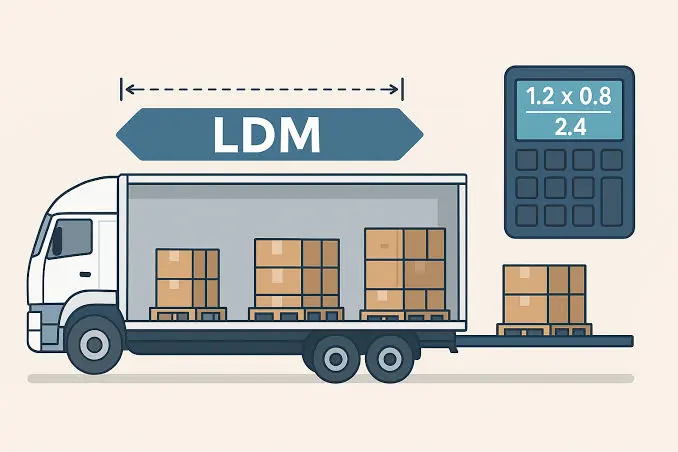
A pallet in loading metres
On a 2.40 m loading width, a Euro pallet that cannot be stacked is 0.40 LDM and an industrial pallet is 0.50 LDM. If the pallet is declared stackable, count half, because a second one rides on top.
Whether the pallet can be stacked moves the result more than a small measuring error. Confirm it on the quote.
| Pallet | Footprint | Non-stackable | Stackable |
|---|---|---|---|
| Euro (EPAL) | 1.20 × 0.80 m | 0.40 LDM | 0.20 LDM |
| Industrial | 1.20 × 1.00 m | 0.50 LDM | 0.25 LDM |
| Half (display) | 0.80 × 0.60 m | 0.20 LDM | 0.10 LDM |
Keep the same figure from quote to invoice. A booking of 0.40 LDM per pallet and an invoice of 0.40 LDM do not argue. The argument starts when a pallet was booked as stackable and the dock treats it as not stackable.
Add up the floor
Multiply length by width in metres, then divide by the 2.40 m loading width. A crate of 2.00 × 1.20 m is 2.00 × 1.20 ÷ 2.40 = 1.00 LDM. Add every item that cannot be stacked.
Height never enters this sum. That is what sets a loading metre apart from volumetric weight. Each piece uses the footprint it will actually occupy:
| Item | Footprint | Calculation | LDM |
|---|---|---|---|
| Euro pallet | 1.20 × 0.80 m | 0.96 / 2.40 | 0.40 |
| Industrial pallet | 1.20 × 1.00 m | 1.20 / 2.40 | 0.50 |
| Half pallet | 0.80 × 0.60 m | 0.48 / 2.40 | 0.20 |
| Long crate | 2.40 × 1.20 m | 2.88 / 2.40 | 1.20 |
Round the way the carrier can sell the space. If 0.15 m of floor behind the freight cannot take another piece, that strip is still used. Most tariffs round LDM up to the nearest 0.1.
From metres to a chargeable weight
Multiply the loading metres by the kilograms-per-LDM figure in the tariff. At 1,750 kg per LDM, 1.2 LDM equals 2,100 kg. That figure is the chargeable weight when it is higher than the gross weight and the volumetric weight.
The kilograms per loading metre are a term in that carrier's tariff. They are not one number for the whole industry, and they change by carrier and by service. Read the tariff you are quoting. Worked examples at 1,750 kg/LDM:
| Shipment | LDM | Equivalence | Gross weight | Chargeable |
|---|---|---|---|---|
| 3 pallets, non-stackable | 1.20 | 2,100 kg | 900 kg | 2,100 kg |
| 3 pallets, stackable | 0.60 | 1,050 kg | 900 kg | 1,050 kg |
| 2 dense pallets | 0.80 | 1,400 kg | 1,900 kg | 1,900 kg |
A rate file that stores this ratio per carrier can apply it next to the volumetric ratio and keep the higher of the two, so the quote is not recalculated by hand each time.
When the tariff sells floor space
When the floor is what runs out: pallets that cannot be stacked, machinery, frames, doors, and other long pieces. Part loads of about 4 to 13.6 LDM are also sold this way, because a weight band no longer describes the space.
Three cases usually move a lane onto an LDM tariff. Freight that cannot be stacked, so the height above it is empty. Part loads, where the buyer is taking a length of floor rather than a place on a scale. And outsized pieces whose footprint does not sit in a weight band.
A tariff written in loading metres prices that shipment directly. It does not push the same freight through a weight scale it does not fit.
FAQ
Questions that come up on a quote
Only when it cannot be stacked and the loading width is 2.40 m. Declared stackable, it is 0.2 LDM, because another pallet is loaded above it.
The number printed in the tariff. Kilograms per LDM are set by each carrier. They are not a single industry constant, so read them from the tariff.
Yes. It is set per carrier, and often per service, in that carrier's tariff. The same shipment can become a different chargeable weight with a different carrier, so check it before you compare quotes.
Open the pallet sizes behind these metres
Euro and industrial pallets are what most of these sums start from. The pallet page lists the footprints, weights, and regional sizes.