
Sea cargo reference
20' Bulk
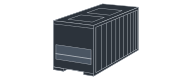
Hatches in the roof for dry bulk. The figures below are the inside of the box, the door, and the weights.
- Internal length
- 5.934 m
- Internal width
- 2.358 m
- Internal height
- 2.340 m
- Door opening, width
- 2.335 m
- Door opening, height
- 2.292 m
- Cubic capacity
- 32 m³
- Empty weight
- 2450 kg
- Payload
- 21550 kg
How a 20' Bulk is used
A twenty-foot closed shell with loading hatches in the roof, and normally a way to discharge at the door end.
Free-flowing dry bulk is gravity-loaded through the roof hatches, then either tipped out on a tilting chassis or discharged through hatches at the far end. That avoids bagging the cargo, or fitting and then throwing away a liner bag in a standard box.
Bulk cargo is dense, so the payload limit is reached long before the container looks full. Weight, not volume, decides how much can be loaded.
Cargo it suits
How the box is made
- A dry-box shell with round loading hatches cut into the roof, spaced along the centre line.
- Discharge hatches sit at the door end, or the whole unit can be tipped on a tilting chassis.
- Walls are reinforced for the sideways pressure a bulk load puts on them once the box is full.
- Three loading hatches in the roof, each roughly 455 mm across, set about 1.83 m apart from centre to centre.
- Two discharge hatches at the door end, sometimes with short tubes to guide the cargo out. On some units the unloading hatches are mounted in the doorway itself.
- Lashing rings in the top side rails, and forklift pockets on some units, so the container can still work as an ordinary box for general cargo.
Why shippers choose it
- There is no cost of bagging the cargo, and no liner bag to fit into a standard box.
- Gravity loading through the roof, and a fast discharge at the far end, cut time in the terminal.
- Outside bulk work the unit still runs as an ordinary closed container.
Check these before you book
- It only suits cargo that flows freely. Anything that bridges or cakes will not come out cleanly.
- The weight limit is reached well before the box looks full, so payload decides the load, not volume.