
Sea cargo reference
20' Refrigerated
Its own cooling plant at one end. The figures below are the inside of the box, the door, and the weights.
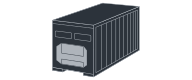
- Internal length
- 5.724 m
- Internal width
- 2.286 m
- Internal height
- 2.014 m
- Door opening, width
- 2.286 m
- Door opening, height
- 2.067 m
- Cubic capacity
- 26 m³
- Empty weight
- 2550 kg
- Payload
- 21450 kg
How a 20' Refrigerated is used
A twenty-foot unit with insulated walls and its own refrigeration plant. It holds a chosen temperature for chilled or frozen cargo for the whole journey.
Both the insulation and the machinery take space, so the inside and the capacity fall well short of a dry twenty-foot box. That is the price of temperature control, and it should be allowed for when you work out how much cargo will actually fit.
The unit needs power the whole way: on the ship, while it waits in the terminal, and on the road or rail leg. Confirm the setpoint against the commodity before loading. Chilled and frozen cargo tolerate very different ranges.
Cargo it suits
How the box is made
- Insulated panels, typically polyurethane foam injected between steel skins, sit on a standard steel container frame.
- A refrigeration unit is built into one end. It runs on three-phase power from the ship, the terminal, a road genset or a rail supply.
- A T-bar or deep-grooved floor lets chilled air travel under the cargo for the length of the box and return over the top.
- The lining, usually stainless steel or aluminium, can be washed down between cargoes.
- A control panel shows the setpoint and the supply and return air temperatures. Modern units also keep a data log.
- Outside sizes meet ISO, so the unit drops into a ship's cell guides the same way a dry box does.
- The floor is a grate so chilled air can travel under the cargo, and the side walls are corrugated so the air keeps moving there too. Pallets open one more channel for the air.
- Leave at least 12 cm clear above the cargo so the air can return. The maximum load height is marked on the side walls.
- Besides holding temperature, the unit can exchange fresh air and vent the carbon dioxide and ethylene that fruit gives off.
- Both supply and return air temperatures are measured. The display sits on the outside, so the unit can be checked without opening the doors.
- Where the ship's power is short, diesel packs built to 20 ft ISO size can feed the units. On road and rail a generator set does the same job.
- Chilled meat is sometimes hung, on hook rails fitted to the ceiling.
Why shippers choose it
- Holds a chosen setpoint from deep frozen to chilled, whatever the weather outside.
- It handles and stacks like a dry box. The terminal only needs a power point.
- The temperature log travels with the cargo and can be produced on delivery.
- Some units offer a controlled or modified atmosphere, which stretches the shelf life of fresh produce on a long voyage.
Check these before you book
- Insulation and machinery both take space, so the inside and the capacity fall well short of a dry container.
- Power has to stay on for the whole journey, including time in the terminal and the inland legs.
- Cargo has to be stowed so air can move. Packing tight to the walls, or above the red load line, stops the unit doing its job.