
Sea cargo reference
40' Flatrack
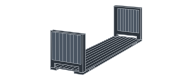
The heaviest payload among the flatracks. The figures below are the inside of the box, the door, and the weights.
- Internal length
- 11.832 m
- Internal width
- 2.228 m
- Internal height
- 1.981 m
- Door opening, width
- Does not apply
- Door opening, height
- Does not apply
- Cubic capacity
- Does not apply
- Empty weight
- 4200 kg
- Payload
- 40800 kg
How a 40' Flatrack is used
A forty-foot open bed with end walls, rated for the heaviest payload of any flatrack in common service.
It is the usual answer for cargo that is both long and dense: structural steel, pipe bundles, large fabrications and industrial plant. The underframe is built for that weight, but the load has to be spread along the bed, not piled over a short span.
Cargo may overhang the sides and the ends. Over-width or over-length cargo changes how the unit is stowed on board and how it can move inland, so both need checking before booking.
Cargo it suits
How the box is made
- A steel deck on a reinforced underframe, rated for a heavy point load rather than a load spread evenly.
- End walls only. They are fixed on a standard unit and hinged on a collapsible one. There are no side walls and no roof.
- Lashing rings sit in the side rails, often with pockets for stanchions.
- Corner castings sit in the standard ISO positions, so the unit handles and stacks like any other container.
- A steel frame with a softwood floor. The end walls are strong enough to take cargo lashings and to let several flatracks stack.
- Lashing rings sit in the side rails, the corner posts and the floor, rated to 4,000 kg on 40 ft units.
- Gooseneck tunnels at both ends. Some units carry lashing winches with two-tonne belts.
- Stanchions can be fitted when the cargo needs uprights.
Why shippers choose it
- Takes cargo wider and taller than any closed unit can accept.
- The payload rating is high, which suits dense cargo such as steel, stone and machinery.
- Loading can come from the side or from above, so the door opening never limits the piece.
Check these before you book
- Cargo is fully open to weather and spray, and it usually needs wrapping or sheeting.
- Lashing and weight distribution are worked out for each shipment. Over-width or over-height cargo also limits what can be stowed next to it.