
Sea cargo reference
45' Pallet Wide
Wide enough for two europallets side by side. The figures below are the inside of the box, the door, and the weights.
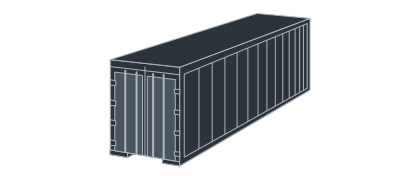
- Internal length
- 13.560 m
- Internal width
- 2.452 m
- Internal height
- 2.684 m
- Door opening, width
- 2.343 m
- Door opening, height
- 2.670 m
- Cubic capacity
- 85.0 m³
- Empty weight
- 4180 kg
- Payload
- 29820 kg
How a 45' Pallet Wide is used
A forty-five foot high-cube whose internal width is increased just enough to take two standard 1200 × 800 mm europallets side by side across the box.
In a normal container those two pallets do not quite fit abreast, which leaves a dead strip of floor the length of the unit. Closing that gap lifts the pallet count for the same voyage. That is why pallet-wide equipment is common on European traffic, where the europallet is the standard load unit.
Finding one is the main limit. Like other forty-five foot equipment it is not accepted on every service or inland route, and the pallet-wide width is itself a specialist build. Confirm both before the cargo is committed.
Cargo it suits
How the box is made
- A welded steel frame with a corner casting on each of the eight corners. Those castings take the crane spreader, the twistlocks that hold the box to the deck, and the lashings that secure it.
- Side walls and roof are pressed from corrugated low-alloy weathering steel. The corrugation stiffens the panel. The alloy grows a protective oxide skin instead of rusting through.
- Double doors sit at one end. Vertical locking bars with cam fittings pull each door tight against the frame.
- A rubber gasket runs the full edge of the door opening and seals against driven rain and dust.
- The floor is thick marine plywood, usually film-faced, bolted to steel cross-members that carry forklift wheel loads.
- Lashing points run along the side rails and at floor level so cargo can be secured inside.
- Internal width is increased to roughly 2.45 m so two europallets sit abreast. External width stays inside ISO limits.
- The frame is steel beams. Side walls and roof are corrugated low-alloy steel.
- Double doors with bar locks, sealed by a rubber gasket around the whole door opening.
- The floor is corrugated film-faced plywood on steel U-beams.
- Fitting feet are screwed to every side so handling gear can take the box.
Why shippers choose it
- Running costs stay low. Upkeep is mostly dents, door seals and floor boards.
- The same sealed box moves by ship, rail and road. The cargo is not handled again at each change of mode.
- Corner castings sit in the ISO positions, so any crane, spreader, chassis or railcar can take the box.
- The box is weatherproof and can be locked, which limits both moisture damage and theft.
- This is the most widely available equipment, so a booking rarely fails because no box is free.
- The frame supports itself and stacks, so a retired unit is still useful for site storage or a modular building.