
Sea cargo reference
20' Standard
The closed box most freight travels in. The figures below are the inside of the box, the door, and the weights.
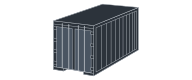
- Internal length
- 5.895 m
- Internal width
- 2.350 m
- Internal height
- 2.392 m
- Door opening, width
- 2.340 m
- Door opening, height
- 2.292 m
- Cubic capacity
- 33 m³
- Empty weight
- 2230 kg
- Payload
- 28230 kg
How a 20' Standard is used
This is the general-purpose box that carries most of the world's containerised freight. It is closed on all sides, with double doors at one end. Some variants have doors at both ends, or doors along one side for cargo that has to be loaded sideways.
At twenty feet it is the natural choice for dense cargo, because it hits the weight limit long before it runs out of room. With something heavy, floor area is never the limit that binds. The payload is.
It is also the unit the industry counts in. One 20' box is one TEU, the twenty-foot equivalent unit used for ship capacity, terminal throughput and trade volumes.
Cargo it suits
How the box is made
- A welded steel frame with a corner casting on each of the eight corners. Those castings take the crane spreader, the twistlocks that hold the box to the deck, and the lashings that secure it.
- Side walls and roof are pressed from corrugated low-alloy weathering steel. The corrugation stiffens the panel. The alloy grows a protective oxide skin instead of rusting through.
- Double doors sit at one end. Vertical locking bars with cam fittings pull each door tight against the frame.
- A rubber gasket runs the full edge of the door opening and seals against driven rain and dust.
- The floor is thick marine plywood, usually film-faced, bolted to steel cross-members that carry forklift wheel loads.
- Lashing points run along the side rails and at floor level so cargo can be secured inside.
- Built with several door layouts: doors at one end, at both ends, or extra doors along part or all of one or both sides.
Why shippers choose it
- Running costs stay low. Upkeep is mostly dents, door seals and floor boards.
- The same sealed box moves by ship, rail and road. The cargo is not handled again at each change of mode.
- Corner castings sit in the ISO positions, so any crane, spreader, chassis or railcar can take the box.
- The box is weatherproof and can be locked, which limits both moisture damage and theft.
- This is the most widely available equipment, so a booking rarely fails because no box is free.
- The frame supports itself and stacks, so a retired unit is still useful for site storage or a modular building.