
Reference
LD-3
The lower-hold unit most airlines fly. The IATA code, rate class, weights, volume and aircraft fit are below.
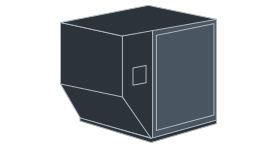
- IATA code
- AKE contoured container
- Code prefixes
- AKE, AVA, AVB, AVC, AVK, DVA, DVE, DVP, XKS, XKG, and forkable AKN, AVN, DKN, DVN, and XKN
- Rate class
- Type 8
- Door size
- 147 x 155 cm (58 x 61 in)
- Aircraft it fits
- A300, A310, A330, A340, 747, 767, 777, DC-10, MD-11, L-1011 lower hold
- Max gross weight
- 1,588 kg (3,500 lb)
- Empty weight
- 82 kg (181 lb)
- AS1825 volume
- 4.5 m³ (159 ft³)
How the LD-3 is used
A half-width lower-hold container with one angled side, built to the AKE code. The door is a canvas curtain or a solid panel.
Two LD-3s sit side by side across a widebody belly, which makes this the usual building block for lower-hold cargo and the most common ULD in service. The prefix family is large, and forkable versions can move by forklift as well as by dolly. It loads on essentially every widebody flying.
Cargo it usually takes
How this family is arranged
- A half-width lower-deck unit with one angled side, so a pair sits across a widebody belly.
- The door is a canvas curtain or a solid panel, depending on the build.
- Forkable versions use the AKN, AVN, DKN, DVN and XKN prefixes.
- Aluminium sheet on an extruded aluminium frame. The structure stays as light as it can, because every kilogram of empty weight takes the place of paying cargo.
- A flat base with hardened edge rails locks into the aircraft latch and roller system, so the unit stays put without separate lashing.
- One or two sides are angled to follow the fuselage curve, so the unit fills the belly cross-section instead of leaving empty corners.
- The door is either a canvas curtain with restraint straps built in, or a hinged solid panel.
- Forkable variants have channels so a forklift can move them, as well as a dolly and a loader.
Why operators pick it
- It fills the curved belly space that loose cargo would leave empty.
- The whole unit goes on and off in one lift, which keeps the turnaround short.
- The cargo is restrained in flight, so each piece does not need its own tie-down.
- Airlines and aircraft can swap the unit under the IATA identification system.
Settle these points before you book
- Empty weight counts against the payload, so a heavier unit carries less cargo for the same rate.
- The load must stay inside the contour. Anything above the profile fouls the hold and is rejected at build-up.
- A canvas door keeps weather out. It is not a secure closure.