
Reference
LD-7 with Angled Wings
Wings set at a fixed angle. The IATA code, rate class, weights, volume and aircraft fit are below.
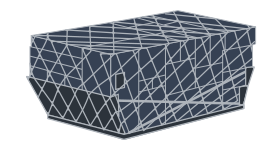
- IATA code
- XAW P1P pallet with fixed-angle wings and net
- Rate class
- Type 5
- Aircraft it fits
- 747, 777, 787, DC-10, MD-11 lower holds
- Max gross weight
- 5,000 kg (11,023 lb)
- Empty weight
- 170 kg (375 lb)
- AS1825 volume
- 14.0 m³ (495 ft³)
How the LD-7 with Angled Wings is used
An LD-7 P1P base with wings set at a fixed angle, built to the XAW code.
The wings stay at that angle, so the structure is simpler and stiffer, and less flexible when the unit is empty. The rating is the same 5,000 kg and 14.0 m³ as the folding-wing build, with a little more empty weight.
Cargo it usually takes
How this family is arranged
- A P1P pallet base fitted with fixed-angle wings, which support cargo hanging past the base.
- The wings stay at a set angle.
- A flat aluminium sheet base with hardened edge rails that lock into the aircraft restraint system.
- Cargo is built on the base and held by a net pulled onto the edge rails.
- A contoured build follows the hold profile. A squared-off build uses the full main-deck height.
- Wing variants add hinged or fixed-angle side extensions for cargo that hangs past the base.
Why operators pick it
- It takes cargo of almost any shape, because nothing encloses it.
- Empty weight is the lightest of any ULD for that footprint, so more of the allowance goes to cargo.
- Empty units stack flat, which keeps the cost of moving them back down.
Settle these points before you book
- The cargo is open and the net is the only restraint, so the quality of the build-up decides whether the load arrives whole.
- The finished load has to match the hold contour or it will not fit.
- Nets and edge rails wear. Both are checked before the unit is accepted.