
Sea cargo reference
Asphalt Carriers
Tanks kept hot enough to pump bitumen. The notes below cover the cargo, the way the hull is arranged, and the limit that puts a ship in this class.
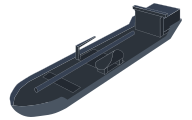
- Ship's gear
- Self-discharging by heated pump system
- How capacity is counted
- Deadweight tonnes (DWT)
- Usual size
- Commonly 3,000-15,000 DWT
- Cargo type
- Bitumen and asphalt
Asphalt carriers
Small tankers for bitumen and asphalt. At ordinary temperature the cargo is solid, so it has to stay hot to remain pumpable.
The tanks are heavily insulated and fitted with heating coils. They hold the cargo hot enough to pump, typically around 150 to 180 degrees Celsius. Heat comes from a thermal oil system that circulates through the coils. Pipelines and pumps are heated and traced to the same standard, because cargo that cools anywhere in the system sets solid and blocks it.
The trade is usually short-sea, from a refinery to a regional terminal that serves road building, so the ships stay small.
Cargo on board
How the hull is arranged
- A double hull keeps cargo tanks off the sea, with ballast space on the sides and bottom. MARPOL requires this on oil tankers.
- The cargo sits in several tanks. Longitudinal and transverse bulkheads limit how far the liquid can slosh.
- An inert gas system holds the tank atmosphere below the oxygen level at which the vapour could catch fire.
- Cargo pumps and a fixed pipeline meet a manifold amidships, so the ship pumps its own cargo ashore.
- Tanks for cargo that must stay warm enough to pump carry heating coils.
Why this trade uses it
- Large volumes of liquid move with no packaging.
- The ship pumps itself out, so a terminal needs pipes and tanks rather than heavy cranes.
- Separate tanks let several grades travel on one voyage without mixing.
Settle these points before you fix
- Washing tanks between cargoes costs time and money. What the ship carried last decides what it may load next.
- Oil majors vet ships on top of class and flag rules, and that vetting decides who will take the ship.
- Pollution liability is heavy. Ship and terminal both follow strict transfer rules.