
Sea cargo reference
Containerships
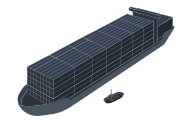
Cell guides built around a standard box. The notes below cover the cargo, the way the hull is arranged, and the limit that puts a ship in this class.
- Ship's gear
- Mostly gearless; smaller feeders may be geared
- How capacity is counted
- Twenty-foot equivalent units (TEU)
- Usual size
- From a few hundred TEU to over 24,000 TEU
- Cargo type
- ISO containers
Containerships
The idea is simple: goods travel in a standard box that stays closed from shipper to consignee. Vertical cell guides drop each box into the hold, and more boxes stack on the hatch covers.
Capacity is counted in TEU, the twenty-foot equivalent unit. The spread is wide. A small feeder carries a few hundred. The largest ships on the Asia-Europe run exceed 24,000 TEU.
Boxes made long supply chains workable. Time in port fell from weeks to hours, theft of loose cargo dropped, and the cost of moving manufactured goods fell far enough that distant sourcing made sense.
Cargo on board
How the hull is arranged
- Holds are cellular. Vertical guides drop each box into place, so nothing is lashed loose below deck.
- Hatch covers are also the floor for boxes on deck. Lashing bridges and twistlocks hold the stacks.
- The hull is drawn for speed and for the twist that a wide, open structure has to carry.
- Reefer plugs on deck and in the holds keep cooled boxes powered for the whole voyage.
Why this trade uses it
- The goods are already in a box, so the ship spends far less time in port than it would on break-bulk.
- The same box moves from ship to rail to road without the goods being handled again.
- The largest ships carry so many boxes that the cost of each one stays low.
- Sailings are published, so a shipper can plan against a liner timetable.
Settle these points before you fix
- The biggest ships only call at deepwater terminals whose cranes reach the outer stacks.
- Stack weight and stability mean a ship seldom fills both its weight limit and every slot.
- A wrong declared weight or content is a standing safety risk. It is a known cause of stack collapse and fire.