
Sea cargo reference
Product Tankers
Coated tanks for refined oil. The notes below cover the cargo, the way the hull is arranged, and the limit that puts a ship in this class.
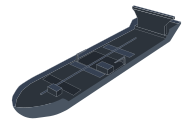
- Ship's gear
- Self-discharging by cargo pump
- How capacity is counted
- Deadweight tonnes (DWT)
- Usual size
- Commonly 10,000-75,000 DWT
- Cargo type
- Refined petroleum products
Product tankers
These tankers move refined oil (petrol, diesel, jet fuel, naphtha and gasoil) from a refinery to a distribution terminal.
The tanks are coated, usually with epoxy. The coating keeps the cargo clean and lets the ship change grade after a wash. Separate tanks and separate pumps let several grades travel together without mixing.
The trade splits into 'clean' products, which need the coating and a careful wash, and 'dirty' products such as fuel oil, where staining matters much less.
Cargo on board
How the hull is arranged
- The trade has size names of its own. Handymax covers smaller ports. Medium Range (MR) is the most widely traded product-tanker size, used where the volumes and the port gear are larger.
- A double hull keeps cargo tanks off the sea, with ballast space on the sides and bottom. MARPOL requires this on oil tankers.
- The cargo sits in several tanks. Longitudinal and transverse bulkheads limit how far the liquid can slosh.
- An inert gas system holds the tank atmosphere below the oxygen level at which the vapour could catch fire.
- Cargo pumps and a fixed pipeline meet a manifold amidships, so the ship pumps its own cargo ashore.
- Tanks for cargo that must stay warm enough to pump carry heating coils.
Why this trade uses it
- Large volumes of liquid move with no packaging.
- The ship pumps itself out, so a terminal needs pipes and tanks rather than heavy cranes.
- Separate tanks let several grades travel on one voyage without mixing.
Settle these points before you fix
- Washing tanks between cargoes costs time and money. What the ship carried last decides what it may load next.
- Oil majors vet ships on top of class and flag rules, and that vetting decides who will take the ship.
- Pollution liability is heavy. Ship and terminal both follow strict transfer rules.