
Sea cargo reference
Kamsarmax
Length set by one bauxite berth. The notes below cover the cargo, the way the hull is arranged, and the limit that puts a ship in this class.
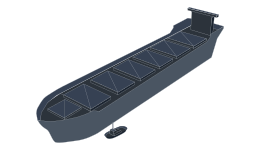
- Typical deadweight
- Typically about 80,000-85,000 DWT; the original design was about 82,000 DWT
- Length overall
- Maximum 229 m
- Beam
- Commonly about 32.26 m
- The limit that names it
- Maximum length at Port Kamsar, Guinea
- Ship's gear
- Usually gearless
- Usual trade
- Bauxite and general dry bulk
- Typical draught
- About 14.5 m
- Cargo holds
- 7
Names such as Handysize, Supramax and Capesize are market habits, not a written standard. Brokers, exchanges and owners do not all use the same deadweight band. Canal and berth limits below are published figures and stay fixed. The deadweight ranges are a guide.
Kamsarmax bulkers
The name comes from one berth. Port Kamsar in Guinea, the main bauxite loading terminal, cannot take a ship longer than 229 metres.
Designers kept that length and made the hull deeper and fuller to win the cargo back. The result is a ship of roughly 82,000 DWT, several thousand tonnes more than a traditional Panamax on a shorter hull.
The ship proved efficient enough that Kamsarmax tonnage now trades well beyond the bauxite routes it was drawn for, and it has become a standard size for new ships.
Cargo on board
How the hull is arranged
- One deck, with large holds closed by steel hatch covers that roll or fold aside for grabs and conveyors.
- Ballast sits in the double bottom and in the topside and hopper tanks. Those tanks also shape the hold so the cargo trims itself as it settles.
- Corrugated bulkheads stand between the holds. They take the push of a dense cargo without extra frames inside the space.
- Engine and accommodation sit aft, so the forward length stays free for cargo.
- Geared ships carry deck cranes or derricks between the hatches and can work where the port has no gear of its own.
Why this trade uses it
- A dry commodity moves with no bags, boxes or lashings, which keeps the cost per tonne low.
- Where the shore gear is good, grabs, conveyors and shiploaders shift thousands of tonnes an hour.
- A geared ship can call at ports that have no cranes.
- Holds can take several parcels of different commodities on one voyage.
Settle these points before you fix
- Iron ore and other dense cargoes load the hull hard. The loading order is strict, so the ship is not overstressed.
- Some concentrates and fines can turn liquid. They have to be checked against the transportable moisture limit before loading.
- Draft and air draft decide which berths and waterways the ship can use. Both shift with the season and the fresh-water allowance.