
Reference
Ilyushin Il-76TD
Ramp freighter built for rough, poorly equipped strips. Payload, hold, door and the job it usually flies are below.
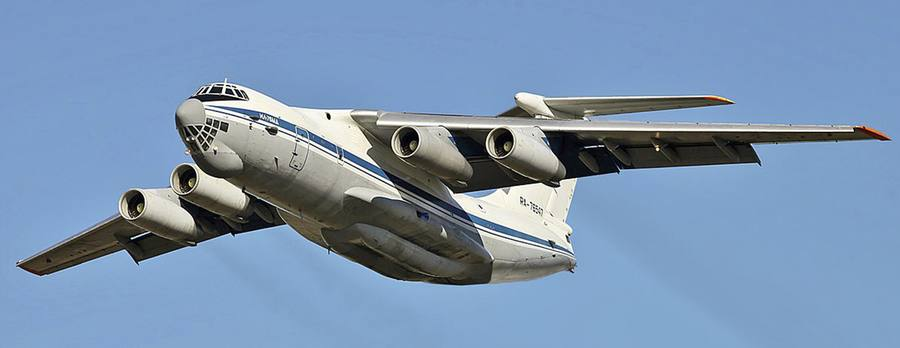
- Structural payload
- 48,000 kg
- Hold volume
- 180 m³
- Hold length × width × height
- 20.00 × 3.45 × 3.40 m
- Main cargo door
- 3.45 × 3.25 m
How the Ilyushin Il-76TD is used
A high-wing ramp freighter made to work from unpaved and poorly equipped strips. The multi-wheel undercarriage is built for rough surfaces.
That is the point of the type: it delivers heavy and outsize cargo where there is no cargo handling at all. It remains a regular tool for relief, mining and remote-project logistics.
Cargo it usually takes
How this family is arranged
- The hold is sized around the load, with a cross-section that stays nearly constant along its length.
- A nose door, a tail ramp, or both let cargo be driven or winched in at floor level.
- The floor is rated for concentrated point loads, with heavy lashing points built into the structure.
- Ramp freighters use a high wing, so the floor sits close to the ground and the hold stays clear of the wing box.
- Some types carry their own cranes and winches, so they can load where there is no ground gear.
Why operators pick it
- It takes pieces that cannot be split: turbines, generators, locomotives, satellites, other aircraft.
- Ramp loading does not need a main-deck loader, so airports with almost no cargo gear can still accept it.
- Self-loading gear makes the aircraft usable at remote sites and on relief flights.
Settle these points before you book
- This is charter work. Lead time and price are agreed for each movement.
- The fleet is small and demand comes in bursts. The usual limit is whether an aircraft is free.
- An outsize piece needs a survey, engineering, and often a purpose-built cradle before the aircraft is booked.